Why Your Blood Work Is Normal But You Still Feel Awful — And What HTMA Can Reveal
If you've ever felt like something is off — fatigue that won't budge, brain fog, mood swings, stubborn weight, digestive problems, and yet your standard blood work comes back "normal," you are not alone. And more importantly, you may not have been looking in the right place.
Hair Tissue Mineral Analysis (HTMA) is a sophisticated laboratory test that measures the mineral content stored in your hair. Those mineral levels paint a remarkably detailed picture of your body chemistry over the past two to three months — including nutritional imbalances, toxic metal burden, metabolic function, and even how efficiently your organs and glands are working.
Let's break down exactly what HTMA is, why it's different from other tests, what it can reveal, and how working with a trained practitioner takes your results from raw data to a real, personalized roadmap for better health.
So What Exactly Is HTMA?
Hair Tissue Mineral Analysis is a laboratory test that analyzes a small sample of scalp hair, about a tablespoon, cut close to the root. It uses a process called ICP-Mass Spectrometry (ICP-MS), one of the most precise analytical instruments in modern science.
The hair that grows from your scalp is nourished by the bloodstream. As it forms, it incorporates the minerals and toxic metals circulating and stored in your body's tissues. Once those minerals are locked into the hair shaft, they stay there. This makes hair a unique biological record of what your body has been doing over months, not just what happened on the morning of a blood draw.
"Your hair holds a record of your internal environment — a months-long story that blood tests simply cannot tell."
Why This Matters
Blood tests give you a snapshot in time, at the moment of the test. HTMA gives you the full film reel: your actual tissue storage levels over time. This is where real nutritional status lives.
The lab used for this testing, Trace Elements, Inc. (TEI), is one of the world's leading hair analysis laboratories, processing over 50,000 samples per year and specializing exclusively in hair mineral analysis. Their methodology and reference ranges are based on decades of clinical research, and each report is built around hundreds of evaluated factors, not just raw numbers.
HTMA vs. Blood & Urine Tests: What's the Difference?
This is one of the most common questions, and the answer matters enormously for your health decisions.
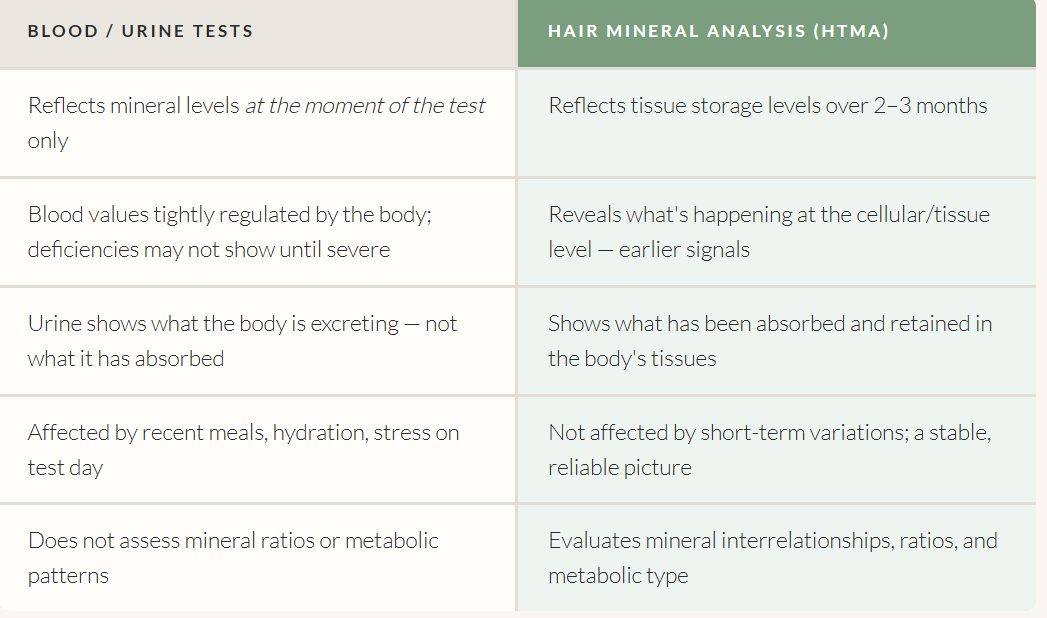
Think of blood and urine tests as photographs, and HTMA as the documentary. Both have value — but only one tells the story of what's really been going on beneath the surface.
What Does HTMA Actually Measure?
A comprehensive HTMA report analyses both nutritional minerals and toxic heavy metals. But the magic isn't just in individual levels; it's in how those minerals relate to one another. The ratios between minerals reveal information about your glandular function, stress response, metabolic rate, and much more.
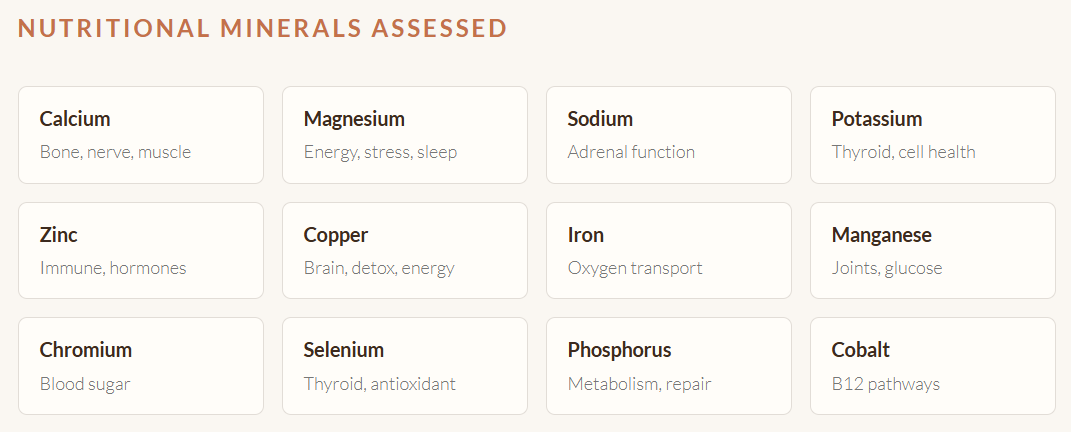
Mineral Examples
Toxic Heavy Metals Screened
HTMA is one of the most effective and accessible tools for identifying heavy metal accumulation in the body, often years before clinical symptoms appear. Metals assessed include lead, mercury, cadmium, arsenic, aluminum, nickel, and more.
An Important Note on Heavy Metals
Elevated toxic metals on an HTMA report don't necessarily mean acute toxicity. They indicate exposure and retention over time, which is valuable information that allows us to support your body's natural detoxification pathways proactively, before symptoms become serious.
What HTMA Reveals Beyond the Numbers
This is where HTMA truly sets itself apart from any other test. A well-interpreted report doesn't just list mineral levels, it reveals the underlying patterns that drive your symptoms and health challenges.
Your Metabolic Type
Your mineral levels reveal whether you are a Fast Metabolizer or a Slow Metabolizer — and this has profound implications for which supplements you should (and shouldn't) take. Taking the wrong supplements for your metabolic type can actually worsen imbalances. A well-matched protocol supports your metabolism instead of working against it.
Adrenal & Thyroid Function
The sodium-to-potassium and calcium-to-potassium ratios are windows into your adrenal and thyroid activity, respectively. These are glands that conventional medicine often dismisses as "fine" based on standard panels, yet they are central to energy, mood, weight regulation, and resilience.
Why "Eating Well" May Not Be Enough
Soil mineral depletion, environmental pollutants, medication effects, genetic factors, gut health, and your individual metabolic type all influence what your body actually absorbs and retains from food. Two people can eat identical diets and have radically different nutritional profiles. HTMA shows your actual status — removing the guesswork from supplementation entirely.
Mineral Interrelationships
Minerals don't work in isolation. Zinc and copper compete. Excess calcium can suppress magnesium. Too much vitamin C can deplete copper. Excess iron creates damaging free radicals. An HTMA report evaluates these interactions, which is why your recommendations may include nutrients that appear "high" on your test or omit those that appear "low." The overall pattern is what guides the protocol.
Who Can Benefit from HTMA?
The short answer: almost anyone. HTMA is not just for the unwell. It's used by athletes optimizing performance, parents monitoring their children's development, and people committed to long-term health maintenance, as well as those actively struggling and seeking answers.
HTMA may be particularly revealing if you're dealing with:
Persistent fatigue or low energy despite adequate sleep
Anxiety, depression, or mood dysregulation
Difficulty losing or maintaining weight
Brain fog or poor concentration
Hormonal imbalances, PMS, or thyroid concerns
Digestive issues and nutrient absorption problems
Hair loss, skin problems, or brittle nails
Known or suspected heavy metal exposure
"Normal" blood work, but persistent symptoms
Pregnancy planning or postnatal recovery
It is also safe and useful for children, and can be retested every three to four months to track progress and update recommendations as your mineral balance shifts.
Why Interpretation Is Everything
Here is something important that is rarely discussed: the raw numbers in an HTMA report mean very little without skilled interpretation. A mineral that appears elevated may actually indicate a relative deficiency. A level that appears low may not need direct supplementation at all.
This is why I don't simply pass along a lab printout. When you complete an HTMA through my practice, I provide a thorough, personalized interpretation of your results, taking into account:
Your full mineral profile and all key ratios
Your metabolic type and what it means for your dietary and supplement choices
Your toxic metal burden and what it suggests about past exposures
Your health history, current symptoms, diet, and lifestyle
Targeted, prioritized supplement and dietary recommendations — specific to you
Follow-up support to review your progress and retest when appropriate
The Difference Personalized Interpretation Makes
There is no such thing as a "standard" HTMA protocol. The right supplements for a Fast Metabolizer are often exactly the wrong ones for a Slow Metabolizer. Getting this right — for your body — is the entire point.
How to Get Started: The Simple Process
1- Book your HTMA consultation with Comprehensive Wellness Assessment
I'll send you everything you need.
2- Receive your Kit and Collect your hair sample at home
Using the simple instructions provided, you take a small sample of scalp hair — about a tablespoon — from the back of your head, close to the root. No clinic visit required.
3- Send to the lab
Your sample is sent directly to Trace Elements, Inc. (TEI), a dedicated hair analysis laboratory processing thousands of samples with rigorous quality control.
4- Receive your personalized report & recommendations
Once the results are back, I analyze your full mineral profile and prepare a comprehensive, personalized interpretation with targeted dietary, lifestyle, and supplement recommendations, along with a wellness roadmap. I walk you through it with a detailed screen video, so you can view it on your own time, OR you can upgrade to an in-person telehealth session. We will walk through everything together.
5- Follow your protocol & retest
Your program is designed to evolve with you. Retesting every three to four months tracks your progress, confirms what's working, and allows your protocol to be refined as your mineral balance improves.