


Building Resilience in Perimenopause (Without Burning Out to Get There)
Feeling depleted in perimenopause? Learn how to build true resilience in midlife using functional strategies rooted in science, not shame.
The Problem Isn’t Just Your Hormones—It’s What You’re Pouring From an Empty Cup
If you’ve ever been told your exhaustion, overwhelm, or brain fog is “just part of aging”—let me say this loud and clear:
🚫 No, it’s not.
Perimenopause is a transformational phase—not a medical malfunction. But when you're juggling careers, caregiving, grief, and a body that no longer “bounces back,” it’s easy to feel like you're breaking down.
You’re not broken. You’re depleted.
And that means the solution isn’t pushing harder…
It’s rebuilding from the root.
Why Midlife Feels Like Everything Is Crashing Down
Here’s what most women don’t realize:
Your 40s and 50s aren’t just about declining hormones.
They’re about decades of stress catching up with your body.
👉 You’ve been sprinting in survival mode for years—maybe even decades.
👉 You’ve been the caregiver, the peacemaker, the do-it-all-er.
👉 And now your nervous system, adrenals, gut, and liver are waving a white flag.
Add in perimenopause (a 7–10 year hormonal rollercoaster), and suddenly everything feels like too much.
That’s not a character flaw. It’s a capacity issue.
The Goal Isn’t “Balance”—It’s Resilience
Balance is static. Resilience is dynamic. It means your body can adapt to stress, recover from illness, and stay grounded even when life throws curveballs.
But resilience isn’t built by accident. It requires you to:
Replenish the systems that have been overworked
Nourish the ones that are underperforming
Protect the parts of you that still feel tender
In functional medicine, we call this building physiological resilience. I call it filling your damn cup.
Start Here: The 5 Pillars of Midlife Resilience
This isn’t about perfection. It’s about progress. These are the foundational areas we assess in every Premiere Wellness Consult inside Nurturing Roots Healing:
1. 🥗 Nourishment: Fuel > Fads
Blood sugar balance is key to stabilizing mood, energy, and hormones
Protein and mineral-rich foods rebuild depleted systems
Forget starvation—your body needs nourishment, not punishment
Your diet is your foundation. You may be eating the wrong foods for your body, even if they are deemed healthy!
2. 😴 Rest: Deep Sleep > Hustle Culture
Sleep isn’t lazy; it’s where healing happens
We should be getting 7-9 hours per day
If you’re waking up tired, we look at cortisol patterns, blood sugar, and more
3. 🧘♀️ Stress: Regulate, Don’t Just Meditate
Nervous system care isn’t a luxury—it’s a strategy
Resilience lives in the regulated nervous system
Daily practices like breathwork, grounding, and nervous system “micro-resets” matter more than one big spa day
4. 🧬 Movement: Rebuild, Don’t Deplete
Perimenopausal bodies don’t respond to workouts like they used to
Too much HIIT or cardio can backfire—raising cortisol and draining energy
Strength training and walking are your best friends
5. 🌿 Supplementation: Personalized, Not Prescribed by Google
We use functional labs to test—not guess—where your body needs support
Adaptogens, mineral repletion, and targeted hormone support make a huge difference
BHRT? Maybe. But only with testing and supervision
Why This Isn’t “Self-Care”—It’s Self-Preservation
Let’s be honest: you’ve probably been the caretaker for everyone else.
But somewhere along the line, you forgot how to take care of yourself without guilt.
This work isn’t indulgent. It’s essential.
💡 You can’t pour from an empty cup. But you also can’t refill it once a year on vacation.
Resilience is built in your daily rhythms, not emergency resets.
What If It’s Not “Just Hormones”?
So many women come to me thinking it’s all about estrogen or progesterone. And yes, hormones play a role—but they’re not the only players.
We often find:
Gut dysbiosis driving inflammation
Liver overload blocking hormone detox
Adrenal burnout tanking energy and resilience
Blood sugar swings sabotaging sleep and mood
That’s why functional testing matters.
We don’t guess—we gather data. And then we create a plan that honors the complexity of your body.
Rooted in Reality: What Resilience Really Looks Like
Resilience doesn’t mean never struggling. It means you:
Know what your body is asking for
Have tools to respond instead of react
Feel safe inside yourself again
It’s not a quick fix. But it is a sustainable one.
You’re not “crazy.”
You’re not lazy.
You’re not unmotivated.
You’re just done being dismissed.
And that’s exactly where your healing begins.
Ready to Rebuild? Here's How We Start
If you're in perimenopause or beyond and feeling like your body’s bandwidth is shot, this isn’t a time to white-knuckle through it.
It’s a time to root in.
👉 Start with a Premiere Wellness Consult—we’ll map your symptoms, review labs, and create a tailored resilience plan that fits your life, not someone else’s protocol.
Book your session here →

FAQ: Building Resilience in Perimenopause
How do I know if I’m in perimenopause?
If you're in your 40s and noticing shifts in mood, cycle, sleep, or energy—you probably are. Perimenopause can start 7–10 years before menopause.
Is this about hormone therapy?
Not necessarily. We address all root causes—hormones, gut health, adrenals, minerals, nervous system function—then support where needed.
How long does it take to feel better?
That depends on how long you’ve been burning out. We focus on sustainable, layered healing—not quick fixes. But many clients feel a shift within weeks of the right support.

Why Hormone Testing Matters Before Starting BHRT (It’s Not Optional)
Hormone therapy isn’t one-size-fits-all. Discover why personalized hormone testing is essential before starting BHRT and how it protects your health.
Don’t Guess, Test
If you’re a woman in midlife navigating the hormone rollercoaster, bioidentical hormone replacement therapy (BHRT) can be a game-changer—but only when it’s done right. That means testing first. Skipping this step? It's like throwing darts in the dark and hoping for balance. Hormone testing is your GPS—helping you avoid side effects, monitor progress, and actually feel better, not worse.
What Is BHRT, and Why It Needs to Be PersonalizedWhy You Can’t Skip Hormone Testing Before BHRT
You’ve probably been there: talking to friends, reading wellness blogs, trying this or that supplement hoping it’ll be the one. But here’s the thing—your body is bioindividual. What worked for your best friend could make you feel worse.
Take it from me: I thought I was estrogen-deficient and almost started estrogen therapy. But after testing, I discovered my estrogen was fine—it was low progesterone making me estrogen dominant. Taking more estrogen? That would’ve poured fuel on the fire.
This is common in perimenopause, when estrogen can fluctuate wildly, but progesterone steadily declines. It’s also why symptom-matching alone is risky. You can feel “off” and still have labs that look “normal” by conventional standards—but functional medicine asks, what’s optimal?
BHRT (Bioidentical Hormone Replacement Therapy) uses hormones that are structurally identical to what your body makes. It’s used to relieve symptoms like:
Hot flashes
Night sweats
Mood swings
Sleep issues
Brain fog
Low libido
But BHRT is not plug-and-play. It requires custom dosing and delivery methods (creams, patches, pellets, oral, etc.), and that customization starts with proper lab testing.
Want to track your symptoms? Take the hormone self assessment.
Start with These Foundational Hormone Tests
Here’s what to ask your provider for before starting therapy:
✅ Blood Tests
Hormone
Optimal Range (not just “normal”)
Estradiol
100–150+ pg/mL (for symptom relief & bone health)
Progesterone
5–10+ ng/mL (or 100–150 ng/dL via LC/MS)
Total Testosterone
50–60 ng/dL
Free Testosterone
~5 pg/mL
DHEA-S
200–430 ug/dL
FSH
Under 25 mIU/mL (if on BHRT)
Note: These are functional/optimal ranges. Lab reference ranges often just show what’s "common"—not what’s ideal.
🧠 The DUTCH Test (Dried Urine)
This advanced test shows not only your hormone levels, but how your body metabolizes and detoxifies them, including:
Estrogen and its potentially harmful pathways
Cortisol (stress hormone)
Androgens like testosterone and DHEA
Knowing this helps you and your provider adjust dosing and spot risks (like estrogen dominance or poor detox pathways).
Additional Testing You Shouldn’t Skip
Before starting BHRT, functional providers also look at:
Thyroid function: Low thyroid can mimic hormone imbalance symptoms.
Gut health: A stool test helps uncover inflammation, poor absorption, and detox issues. Your gut influences hormone metabolism more than you’d think.
Testing Isn’t a One-Time Thing—Here’s the Schedule
Test Type & Frequency
Bloodwork- Every 3–6 months, then annually
DUTCH Test- Every 6–12 months
Stool Testing- Every 2 years or as needed
Think of testing as your hormone check-in. It ensures you’re not just taking hormones—you’re actually benefiting from them.
Real Talk: Common Symptoms When Starting BHRT
Even with proper testing, your body may need time to adjust. Here’s what’s normal at the beginning:
Estrogen-related
Bloating
Breast tenderness
Mood swings
Headaches
Progesterone-related
Drowsiness
Brain fog
Anxiety (yes, even with progesterone)
Testosterone-related
Acne
Hair changes
Libido shifts
📝 Pro Tip: Oral progesterone can be sedating, and each woman’s estrogen sensitivity is unique. Symptoms often resolve as your dose gets fine-tuned.
Perimenopause vs. Post-Menopause: Different Bodies, Different Needs
Perimenopausal women still have fluctuating cycles. Hormone levels can spike unpredictably, increasing risk for estrogen dominance or irregular bleeding.
Post-menopausal women are more sensitive to small doses but typically stabilize quicker once the right balance is found.
Signs You May Need to Adjust Your Hormones
If any of these apply, talk to your provider:
No symptom relief after 2–3 months
Persistent bleeding post-menopause
Mood instability
Severe breast tenderness
Worsening acne or hair thinning
This doesn’t mean BHRT isn’t working—it likely means your dose or delivery method needs adjusting, or your detox pathways need support.
Functional Truth: One Size Does Not Fit All
In my practice and personal experience, I’ve seen too many women go the DIY route—cherry-picking supplements, guessing based on symptoms, or borrowing someone else's protocol.
But here’s the truth: What your body needs is unique.
Testing gives you data, and that data saves you time, money, frustration—and protects your health.
Final Takeaways: What to Remember
✅ Testing before BHRT isn’t optional—it’s essential
✅ Functional ranges matter more than “normal” labs
✅ Bioindividuality means your protocol should be yours
✅ Testing is ongoing, not one-and-done
✅ BHRT is powerful—but only when it’s monitored, personalized, and supported
Ready to Get Rooted in Hormone Balance?
Let’s make sure your body is heard, not guessed at. At Nurturing Roots Healing, we don’t slap a protocol on symptoms—we partner with your body to support the whole system.
FAQs: Hormone Testing & BHRT
Do I really need hormone testing before BHRT?
Yes. It’s how you personalize your plan and avoid guesswork. Skipping testing is like driving cross-country without GPS.
How often should I test my hormones?
Blood every 3–6 months initially, DUTCH every 6–12 months, and stool testing every 1–2 years.
Is it normal to feel worse at first?
Sometimes. It’s often your body adjusting. With good testing and symptom tracking, that window is short.
Can I use symptom tracking alone to adjust my hormones?
You can, but there is may be a lot of trial and error in your tracking, so it can be risky. Symptoms can overlap and be misleading—testing helps to show the root cause.

Feeling Off But Labs Are Normal? You Might Be in Metabolic Chaos™
Metabolic Chaos™ is the body’s breakdown in communication and balance due to hidden stressors that disrupt normal function. While conventional care often chases symptoms, this article reveals why a functional approach is key to resolving chaos at its root—so you can stop guessing and start healing.
Ever feel like your body is falling apart for no good reason? You eat "okay," your labs are "normal," and yet you wake up feeling like a bus hit you.
You're not crazy.
You might be stuck in a state of Metabolic Chaos™.
What Is Metabolic Chaos™?
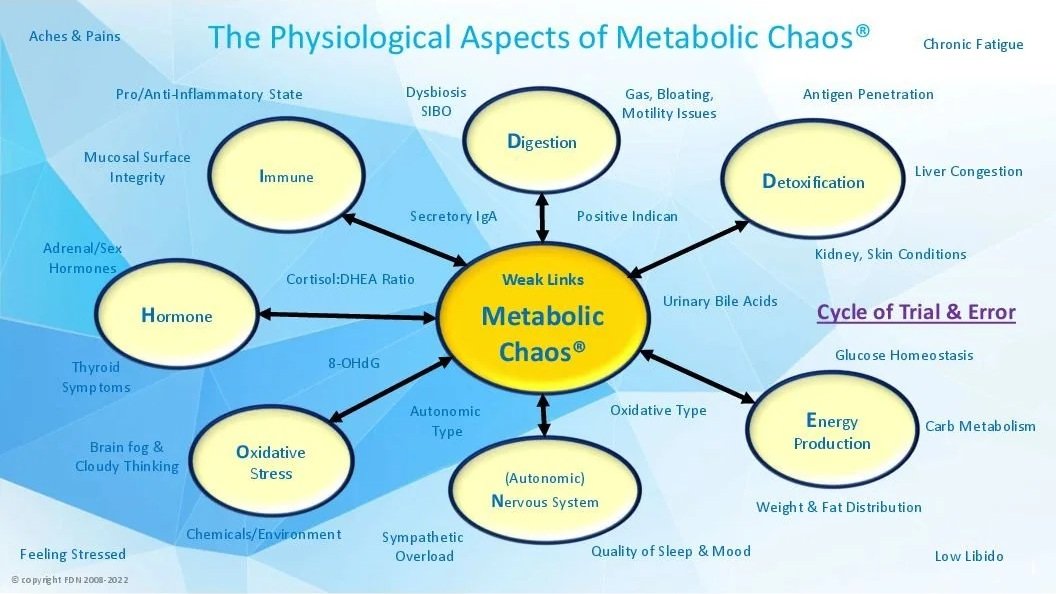
Metabolic Chaos™ is what happens when your body's natural communication and self-regulation systems break down. It's not caused by a single issue, but by the accumulation of stressors that pile on over time—until your body can no longer compensate.
This chaos leads to dysfunction across multiple systems, which often shows up as vague, frustrating symptoms that don't respond to traditional treatments.
Think: fatigue, weight gain, brain fog, joint pain, anxiety, sleep issues, digestive drama—the works.
And yes, your labs might still look "normal."
Metabolic Chaos
Your Body Is Brilliant—Until It Can't Keep Up
Our bodies are innately intelligent. They're designed to heal and regulate on their own, but only if the systems are working in harmony.
When that harmony is hijacked by chronic stress, processed foods, inflammation, poor sleep, unresolved trauma, toxins (hello, modern life), or all of the above—the system breaks.
This is not just aging. This is not in your head. And it is not something another prescription alone can fix.
The Problem with Chasing Symptoms
Conventional and even many alternative approaches tend to treat one system at a time: thyroid, gut, adrenals, nervous system, etc.
But when you're in a state of Metabolic Chaos™, those aren't isolated problems. They're downstream symptoms of upstream dysfunction.
And here’s the kicker: even when you manage one issue, it often pops up somewhere else—worse.
“I had a client with hypothyroidism, hypertension, obesity, and gout. Traditional care helped manage the symptoms, but her quality of life was still tanking. Once we uncovered the hidden stressors behind the chaos, she lost weight without dieting, lowered her blood pressure naturally, and had fewer gout flares.”
What Causes Metabolic Chaos™?
Let me introduce you to the acronym I use with clients: H.I.D.D.E.N. stressors. These are the sneaky drivers of dysfunction:
Hormone Imbalances
Immune dysregulation & inflammation
Digestive dysfunction
Detoxification overload
Energy production issues (think mitochondria)
Nervous system dysregulation
And we can’t forget oxidative stress, which silently damages cells and perpetuates the chaos.
It's usually not one root cause. It’s a web of interactions that keeps your body stuck in survival mode.
How Do We Restore Balance?
Short answer: Not with guesswork, Google, or another supplement aisle splurge.
Healing Metabolic Chaos™ requires a whole-person, systems-based approach. Here’s the basic flow I use in my functional health practice:
🛠️ 1. We Assess the Chaos
We investigate patterns, not just symptoms. We look across your entire physiology to find where your body is stuck.
✨ 2. We Identify Healing Opportunities
We look beyond diagnoses to see where your body needs support. That includes H.I.D.D.E.N. stressors, past trauma, toxic exposure, and more.
🧬 3. We Customize a Plan
Using functional testing, herbal medicine, nutrition, lifestyle shifts, and education, we help your body restore homeostasis—one layer at a time.
Why Functional Health Looks at the Whole Person
As a Functional Nurse Consultant and Herbalist, I don’t treat labs. I treat people.
If you’ve been in the cycle of trying everything and still feel off, it’s time to zoom out. Your metabolism is more than just weight or digestion. It’s the sum of every cell, organ, and system working together.
When those systems aren’t talking to each other, chaos takes over.
But the good news? We can rebuild that communication.
Ready to Restore Balance?
Everyone has a metabolic weak link. For some, it's the gut. Others, hormones. For many, it starts with stress.
No matter where your chaos began, you can be supported.
If you're ready to stop managing symptoms and start uncovering the true healing opportunities, let’s talk.
Book a consultation with me at Nurturing Roots Healing, and let’s bring your body back into balance—one layer at a time.
FAQs
Q: Can I have Metabolic Chaos™ even if my lab work is normal?
A: Yes. Metabolic Chaos™ often hides behind "normal" labs because standard testing doesn’t assess system interactions or chronic stress load.
Q: How is this different from functional medicine?
A: The Metabolic Chaos™ model is rooted in functional philosophy but focuses more on patterns and healing opportunities than diagnoses.
Q: Is there a test for Metabolic Chaos™?
A: Not one test, but multiple functional assessments can help identify the patterns driving your chaos.
Q: How long does it take to feel better?
A: It depends on your individual case, but most clients start noticing shifts within weeks when supported with the right plan.
Slug: /what-is-metabolic-chaos
Meta: Discover how Metabolic Chaos™ happens when multiple body systems go off-track. Learn the hidden stressors and how to begin reclaiming your balance.

Fire Cider: A Spicy, Soulful Tonic for the Whole Family’s Immune Health
Fire Cider is a zesty, time-honored herbal tonic that supports your immune system naturally — made with apple cider vinegar, garlic, ginger, and raw honey. In this post, functional nurse and herbalist [Your Name] shares her family-friendly recipe, tips for adjusting the spice level for kids, and why this fiery blend deserves a spot in every home apothecary.
What Is Fire Cider (and Why It’s a Must-Have for Every Family Medicine Cabinet)
If you’ve ever wanted a simple, natural way to support your immune system through the cold and flu season — Fire Cider is your new best friend.
Fire Cider is a traditional herbal tonic made by infusing apple cider vinegar with powerhouse ingredients like garlic, ginger, horseradish, and chili peppers. It’s been used for generations to boost circulation, fight seasonal bugs, and gently stimulate digestion. Think of it as nature’s version of an immune-boosting shot — fiery, tangy, and packed with plant power.
Why I Love Fire Cider (and What I Learned the Messy Way)
As both a nurse and herbalist, I’ve always been fascinated by how the simplest ingredients can become the most powerful medicine. Fire Cider is one of those magical recipes that bridges the gap between kitchen and clinic.
The first time I made it, I learned two important lessons:
Grating fresh horseradish is no joke — have tissues ready! My nose started running immediately.
Don’t overfill your jar (I did). Leave enough room at the top so the vinegar can fully cover everything.
These little moments remind me that herbal medicine doesn’t have to be intimidating. It’s about connecting with the process — the chopping, the smells, the care you put into each ingredient. It’s part science, part ritual, and it’s so worth it when your family stays healthy all winter long.
Classic Fire Cider Recipe (Mountain Rose Herbs Style)
Here’s the version I love, adapted from the Mountain Rose Herbs recipe — with my own notes for making it family-friendly.
Ingredients:
1 medium organic onion, chopped
10 cloves of organic garlic, crushed or chopped
2 organic jalapeño peppers, chopped (adjust or omit for kids)
Zest and juice from 1 organic lemon
½ cup fresh grated organic ginger root (or 1–2 Tbsp ginger powder)
½ cup fresh grated organic horseradish root (or 1–2 Tbsp horseradish powder)
1 Tbsp organic turmeric powder
¼ tsp organic cayenne powder (omit for little ones if needed, but the benefits are great!)
2 Tbsp dried rosemary leaves
Organic apple cider vinegar (with the “mother”)
¼ cup raw, local honey — or to taste
Directions
Prepare all your roots, fruits, and herbs. Place them in a quart-sized glass jar.
Pour in enough apple cider vinegar to completely cover everything. Leave about 1 inch of space at the top.
Cover with parchment under the lid to prevent corrosion, or use a plastic lid.
Shake well and store in a cool, dark place for about 4 weeks, shaking daily.
Strain the mixture through cheesecloth into a clean jar, squeezing out as much liquid as possible.
Stir in raw honey until fully blended. Adjust sweetness to your taste.
Store in the fridge and enjoy 1–2 tablespoons daily during the colder months, or at the first sign of a sniffle.

How Fire Cider Supports the Immune System
Each ingredient in Fire Cider plays a role in supporting your body’s natural defenses:
Ginger warms and stimulates circulation, helping your body fight off pathogens.
Garlic is naturally antimicrobial and supports respiratory health.
Horseradish clears sinuses and acts as a natural decongestant (you’ll feel that right away!).
Turmeric calms inflammation and supports overall immune resilience.
Lemon adds vitamin C and helps detoxify the liver.
Cayenne increases heat and blood flow, helping other herbs work more effectively.
Raw honey soothes the throat, adds sweetness, and makes this remedy more palatable for kids.
Together, these ingredients create a synergistic blend that helps your body stay strong and recover faster.
Tips for Making It Kid-Friendly
Fire Cider can be spicy! For younger kids or those sensitive to heat:
Skip or reduce the cayenne and jalapeño.
Add a little extra honey when serving.
Mix a spoonful into warm water or herbal tea instead of taking it straight.
My son is firmly in the “no cayenne, please” camp — so I leave it out for the family batch and add a dash later for my own.
When and How to Take Fire Cider
You can take Fire Cider in several ways:
As a daily tonic: 1 tablespoon in water or juice each morning.
At the first sign of illness: 1 tablespoon every 3–4 hours.
As a salad dressing or marinade (yes, it’s delicious!).
It’s one of those kitchen remedies that makes prevention feel easy and empowering — a simple ritual that reminds you to care for yourself daily.
Safety Notes & Herbal Wisdom
Because Fire Cider uses vinegar as a base, it’s shelf-stable before adding honey. Once sweetened, refrigerate it for freshness.
Always check with your healthcare provider if you’re on blood thinners, have ulcers, or are pregnant — though most people tolerate it beautifully.
Remember: herbal medicine works best when combined with nourishing food, rest, and hydration. Fire Cider is a supportive ally, not a cure-all.
Final Thoughts: Stirring Up Health, One Jar at a Time
Making Fire Cider isn’t just about boosting immunity — it’s an act of nurturing roots, connecting you to the old ways of self-care that our grandmothers knew by heart.
Each batch is unique, infused with your own energy, intention, and love for your family. And honestly? The smell alone is worth it.
So grab a jar, grate that horseradish (tissues ready!), and know that you’re reclaiming your role as the caretaker of your family’s health — one fiery spoonful at a time.
*Disclosure: I only recommend products I would use myself and all opinions expressed here are our own. As an Amazon Associate, this post may contain affiliate links that at no additional cost to you, I may earn a small commission.
References
NIH: Benefits of Garlic and Ginger
Herbal Academy: History of Fire Cider